
Reconstruct Pickens County Former Owners
Build the timeline backward from the newest transfer. The grantee on that deed becomes your starting point. Treat the deed's grantor as the next prior-owner candidate, and log the date, names, deed type, book and page, and legal description as you move. Quitclaims, corrective deeds, estate instruments, releases, and plats all belong in the chain whenever they affect a link between Pickens County property records entries.
| Transfer date | Grantor to grantee | Deed type | Book/page |
|---|---|---|---|
| Newest first | Prior owner to present grantee | As indexed | Current GSCCCA result |
| Next earlier | Earlier grantor to that prior owner | As indexed | Matched through name and land |
| Repeat | One verified link per row | Include repair instruments | Continue to historical books |
Mark any link you cannot prove as a gap. A plausible surname sequence is not a deed chain.
Pickens County Deed Coverage Windows
The Kofile QuickLink index covers Pickens County deeds and realty mortgages from 1854 through 1986. GSCCCA sets an all-county deed baseline of at least January 1, 1999. Older material is added over time. No single Pickens cutoff fits every instrument. Neither index announces a complete image range for the county. Treat the gap between coverage windows as a routing question for the Clerk. It is not proof that a deed never existed.
| Record route | Verified span | Best use |
|---|---|---|
| Kofile QuickLink | 1854-1986 | Party, year, book, volume, page |
| GSCCCA deed index | At least 1999 forward statewide | Current deeds and added history |
| Clerk deed books | Office-held series | Missing links and certified copies |
Pickens County Land Descriptions Persist
Prior owners often hide behind old descriptions. A Pickens County deed may be indexed under a road, creek, land lot, district, acreage, subdivision lot, or company tract instead of a modern street number. Carry the legal description forward from deed to deed. Plats and easements often explain why lot or acreage wording shifted over time. For Tate and Nelson land, marble-company names and railroad-era clues can outperform a current mailing address in the property search.
Walk Pickens County Deeds Backward
The backward method tracks party roles, not surnames in bulk. GSCCCA offers grantor and grantee searches. Filters cover county, date, instrument, subdivision, street, map, and book/page. Kofile narrows by type, year, party role, name, and book or volume and page. Use the fewest fields that surface a candidate deed. Then verify the land matches before adding a name to your owner-of-record chain.
- Find the present owner's acquisition deed with that owner as grantee.
- Read the grantor and exact legal description from that transfer.
- Search the grantor as an earlier grantee, then match the same tract.
- Repeat until online coverage ends, then continue through Clerk books or archives.
- Grantor
- The party conveying an interest.
- Grantee
- The party receiving an interest.
- Chain of title
- The linked instruments affecting the same land.
- Reverse index
- An index organized by grantor.
- Quitclaim deed
- A transfer of whatever interest the grantor may hold, without warranty promises.
See Pickens County's Historic Index
The Pickens Kofile QuickLink index reaches back to the county's earliest deed era.
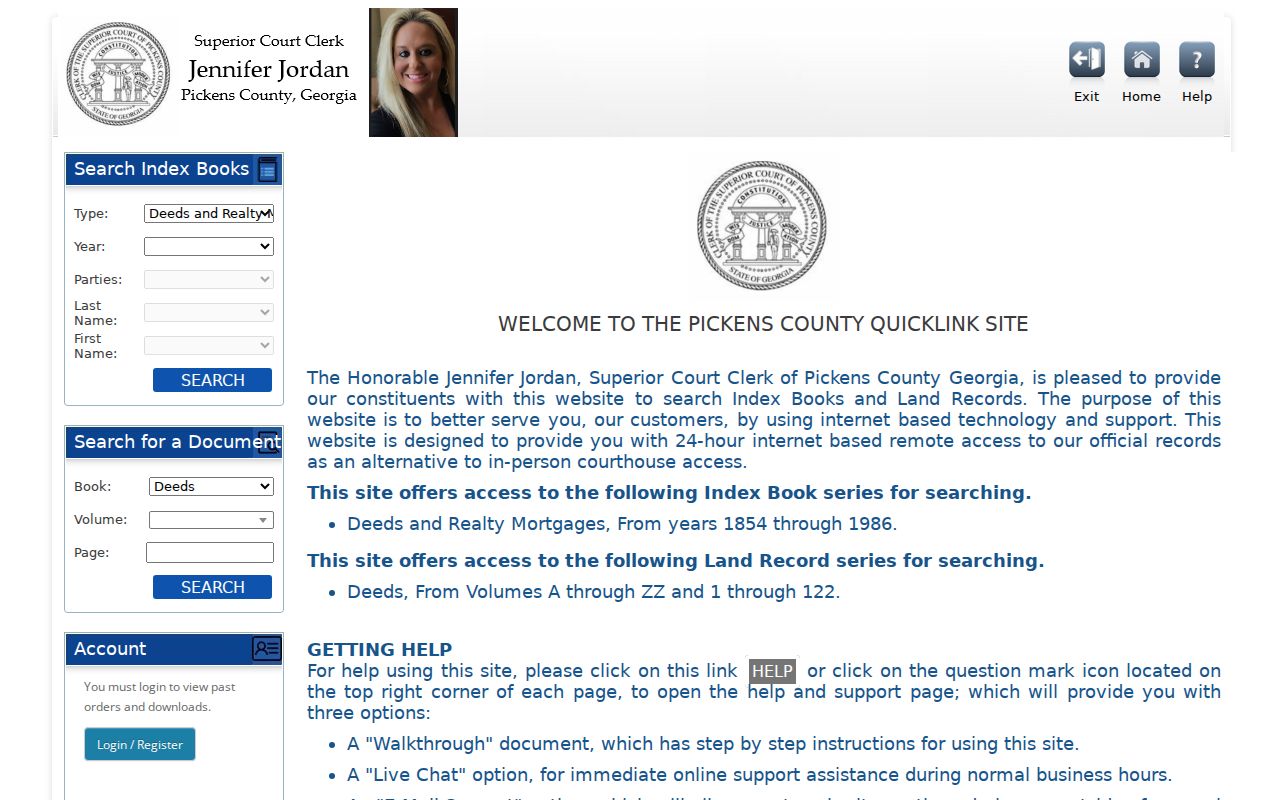
The county's own index page shows the local route into those historic deed books. Image availability varies, so keep every book and page reference for a follow-up with the Clerk.
Follow Pickens County Ownership Branches
Estates, trusts, spouses, and LLCs can interrupt a simple person-to-person chain. Read each signer's capacity and each grantee exactly as written. Georgia Secretary of State business records can decode an entity name, but an officer or registered agent never substitutes for the deed itself. Probate files may explain who had authority to convey. Even so, the recorded transfer remains the property link that matters for former owners.
Pickens County's Fire Record Puzzle
Two fire stories circulate about the Pickens County courthouse. Local sources cite a 1947 courthouse fire, while a separate inventory says Mortgage Book B was apparently destroyed by fire in 1941. Neither claim means every deed vanished. Name the exact record series, then ask the Clerk or library what substitute index, copy, or microfilm survives for that deed-era gap.
Do not force the link. Mark a missing instrument and use plats, tax digests, probate files, and archives only as corroboration.
Older Pickens County Owner Routes
The Georgia Archives research-help route reaches pre-1900 county deeds. It also covers tax rolls, probate files, and related records. FamilySearch catalogs Pickens land books and indexes, though some images require account or affiliate access. The Clerk counter stays the direct county channel for originals. A targeted request should cite names, dates, book and page clues, and the land description. That helps staff locate the deed records quickly.
Log Pickens County Prior Owners
A good worksheet keeps one row per transfer. Add a note for every unresolved break. Record both execution and recording dates when the instrument shows them. Copy grantor and grantee names as indexed. Then add deed type, book and page, legal description, acreage, lot and block, and any plat reference. Flag whether you reviewed the deed image or only an index entry. Save the source URL with your query date. For a corrective deed, note what changed. For a release, state which lien or claim it cleared. This discipline keeps assumptions from hardening into owners of record. It also shows a Clerk or archivist exactly which volume or period needs a manual check. That manual check happens in the property records.
Plats Explain Pickens County Owner Changes
Parcels shift shape over time. A tract can split, combine, or take on new wording while still belonging to a larger parent parcel. That makes a name-only chain look broken even when it is sound. Search the deed's plat book and page, subdivision, lot, block, land lot, district, and acreage to bridge the change. The recorded plat often ties the old tract to the later parcel. County GIS can orient you to the modern PIN. But its geometry serves the assessor and is not a survey. Trust the plat and deed language for the historical link. Jasper's Cove Road annexation at Plat Book W, page 79 shows why. A filed plat can explain jurisdictional wording that a modern ZIP code never will.
Request Pickens County Chain Gaps
The Clerk of Superior Court sits at 50 North Main Street in Jasper. The office is reachable at 706-253-8763. Ask about deed books, plats, mortgages, liens, releases, easements, and certified copies. For other Pickens County records, the open-records process requires a specific description. The county promises a response within three business days. It provides the first 15 minutes of retrieval free. The office charges $0.10 per page. It bills added staff time at the lowest-paid qualified employee rate. A narrow request should name the parcel and the parties. It should also list the record series, approximate year, and any known book and page.
Separate Pickens County Owners From Occupants
A deed grantee held title. That person may never have set foot on the land. A Pickens County parcel can sit vacant. It can carry a lease or sit inside a trust. Some parcels belong to a company. Occupancy clues belong in their own lane. Mailing addresses and old directory entries add color. Yet they never prove who owned the property records show. Build your timeline from recorded deeds alone. Then park directory hints in a notes column beside it. This habit keeps a house history honest. Pickens County property records, after all, describe ownership and not residence.
How Deep Pickens County Owners Go
Pickens County formed in 1853. The earliest online deed index year is 1854 through Kofile. Treat that date as a boundary of the online index, not a promise that every image or chain survives there. Older land context may live in parent-county records, state grants, or archive catalogs. Carry a former owner back only as far as linked evidence goes. A tax digest or newspaper notice can anchor a name to a year, but neither replaces the deed itself in Pickens County property records.
Lawful use. Trace Pickens County prior owners for house history, estates, title work, and purchase diligence. Never use the chain to track or harass a living person.
Cross-Check Pickens County Former Owners
GSCCAA routes widen the lens. Plat, lien, and PT-61 records can each help. They reinforce a deed timeline drawn from Pickens County property records. A plat may connect an old tract to a later lot. A lien release can explain why an encumbrance dropped off the chain. PT-61 entries, when indexed, may add buyer, seller, transfer tax, or sale price. Coverage is not guaranteed for every conveyance, though. Old tax digests and newspaper notices can place a name in a year as well. Use each source as a cross-check. None of them substitutes for the grantor-to-grantee deed link. Keep every row tied to a recorded instrument and the same parcel of land.
Use Pickens County History Carefully
Pickens County became Georgia's 100th county in 1853. The railroad reached the Tate and Nelson marble area in 1883. These dates steer a property search toward early deed books. They also point to company names, land lots, and rail corridors. They still prove nothing about who held a specific tract. The courthouse rebuilt in Tate marble after the later fire tells a preservation story. It says nothing about a given owner of record. It does not show who kept or lost a deed. Log historical clues beside the chain as notes. Then return to the index. Check the recorded instrument, the plat, or the tax series. Each one pins down the same land. That way Georgia history stays helpful. It never plugs an evidentiary hole in Pickens County property records.