
Decode Pickens County Property Tax Records
Pickens County property tax records live in two offices. The Tax Assessor sets parcel characteristics and value. The Tax Commissioner bills, collects, posts payments, tracks delinquency, and runs tax sales. A sound review pairs the assessment year with the matching bill year. It also notes the query date. Keep the parcel number unchanged when moving between both county systems.
| Field | What It Shows | Where |
|---|---|---|
| Owner, address, acreage, map number | Identifies the dated account | Tax Assessor |
| Fair-market and assessed value | Shows estimate and Georgia's 40% assessment level | Tax Assessor |
| Exemptions and net taxable value | Shows relief before tax | Tax Assessor |
| Tax entities, millage, itemized taxes | Explains levy components | Statement and bill |
| Charges, credits, balance, payment | Shows account status | Tax Commissioner |
| Due date and LOST credit | Shows timing and listed credit | Tax statement |
A bill is not a deed, and an assessed figure is not a sale appraisal. The taxpayer name can reflect the January 1 roll even after a later grantee has recorded a deed.
Separate Pickens Property Tax Roles
The Pickens Tax Assessor maintains parcel cards, assessment notices, exemptions, digest work, sales-ratio studies, and appeals from 1266 East Church Street, Suite 121. The office handles valuation. The Tax Commissioner, Daniel Reeves, controls bills, receipts, partial payments, delinquency, and tax-sale administration out of the East Church Street complex. That office handles collection. Call 706-253-8700 for value or exemption questions and 706-253-8882 for billing or payment. Both offices keep weekday hours from 8:00 a.m. to 5:00 p.m. The split matters in practice. A collector does not set value, and an appraiser does not post a payment.
Search Pickens Property Tax Records Six Ways
The Assurance portal offers a tax-year selector and several entry points. Its result is a billing account, not proof of title.
| Control | Best input | Check |
|---|---|---|
| Name | Taxpayer or roll owner | Last-name matching |
| Company | Entity on the bill | Legal-name variants |
| Parcel | Map/PIN reference | Zeroes and segments |
| Bill number | Known bill | Tax year |
| Account | Known tax account | Account versus parcel |
| Address | Known situs | Mailing address differs |
Open the live tax search to check current years and status on the county's own controls.
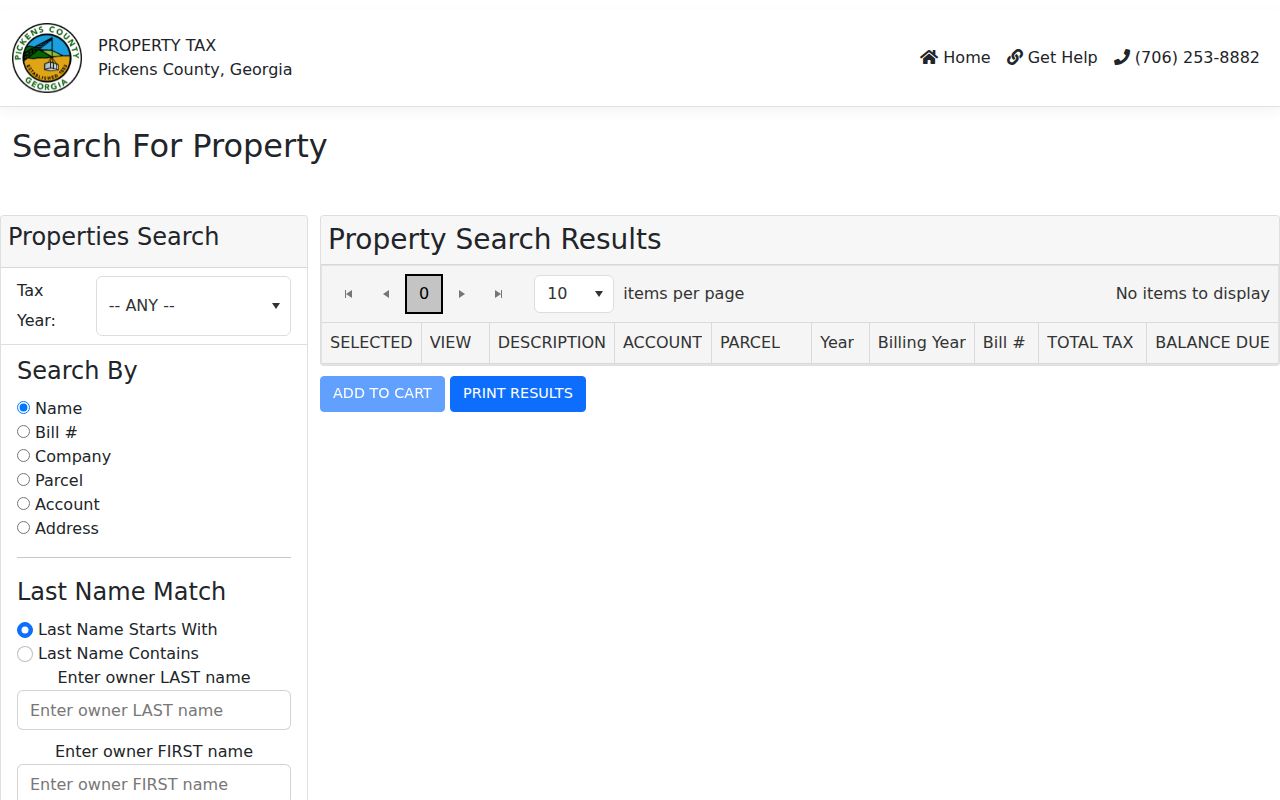
The screen locates a bill. Its selected year, credits, and balance determine what the result actually means.
Look Up a Pickens County Tax Bill
Start with the current map number or PIN, since it is less ambiguous than a name. Choose the intended year, check the account identity, and compare values and exemptions against the assessor card. Save a printout only after confirming parcel and year.
- Find the parcel by PIN, account, bill, address, owner, or company.
- Select the intended tax year and open the matching account.
- Read charges, credits, payments, and balance.
- Compare fair-market, assessed, exempt, and net taxable figures with the assessor.
- Confirm any lien or sale status with the responsible official source.
- Assessed value
- The taxable assessment base, generally 40% of fair-market value before exemptions.
- Millage or levy
- The rate components applied by listed tax entities.
- Homestead exemption
- Qualified relief tied to ownership and residence rules.
- Tax lien
- A recorded claim tied to unpaid tax whose current status must be checked.
Distinguish Three Pickens County Property Tax Values
County material describes fair-market value as an informed estimate of an open-market sale. Assessed value is 40% of that figure. Exemptions lower the net taxable amount that millage applies to. Cost, market, and income approaches may each inform the appraisal depending on the property. A deed consideration or PT-61 sale figure is a different number with a different date. It does not automatically equal the assessor's current market estimate. For interpretation without rebuilding the bill, see the Pickens property values guide.
Find Pickens County Tax Exemptions
The assessor identifies regular homestead, senior, disability, disabled-veteran, Freeport, agricultural, conservation-use, and historical-property programs. Each has separate eligibility. General guidance measures ownership and residence as of January 1 and sets April 1 as the application date for the year.
Use the QPublic landing page for current forms and notices, or ask the assessor which documents apply. Do not assume an exemption transfers on sale or renews under every program. Verify what is actually shown on the parcel record.
Scale the Pickens County Tax Digest
The official digest shows county real and personal value climbing from about $1.603 billion in 2020. It reached $2.912 billion in 2025. The net digest rose from roughly $1.526 billion to $2.641 billion over the same span. These are countywide totals, not a city or parcel trend. Digest movement reflects appraisal changes, new construction, parcel changes, and exemptions. It cannot establish one property's sale value. Compare the parcel's own annual card and assessment notice instead.
Verify Pickens Property Tax Delinquency
The Tax Commissioner handles delinquency, partial payments, and tax sales. Search Assurance for the bill balance. Then confirm sale status through the official tax-sales page. The county publishes no current public parcel list. So an old notice or an unpaid screen is not proof of a scheduled sale. Liens and releases may also surface in GSCCCA's lien index. That index reports statewide coverage since at least January 1, 2004. Tax accounts, liens, legal notices, and sale files are separate records. They may refresh on different schedules.
Why Pickens Tax Owners Can Lag
The Tax Commissioner generally mails the bill to the January 1 owner of record. That owner is the one on record for the tax cycle. If the parcel sells later, the office says the bill should be forwarded to the purchaser. The purchaser may receive it directly the following year. The recorded grantee, the assessor's owner field, and the bill recipient can therefore differ. No office is wrong in that situation. For a recent sale, write down the dates and roles. Read the newest deed for the recorded transfer. Check the assessor roll for the assessment snapshot. Use Assurance for the billed account. A payment by one party does not establish ownership. An out-of-county mailing address does not establish occupancy. When the discrepancy matters to a closing or an estate, confirm directly with the custodians. Confirm the deed and the current bill.
Request Offline Pickens Property Tax Records
Assurance may not show the year or receipt you need. Then go straight to the Tax Commissioner. Ask for the specific bill, the account history, a payment record, or a tax-sale file. Assessment cards, notices, exemption applications, digest records, and appeal files belong to the Tax Assessor instead. Whichever office you contact, give the parcel number and the owner or taxpayer name. Include the tax year, the record type, and the electronic format you want.
Pickens County's open-records terms are generous at the start. The first 15 minutes of retrieval carry no charge, and copies run $0.10 per page. Staff time beyond that is billed at the lowest-paid qualified rate. A response is due within three business days. Production can run longer on a lawful schedule the office provides. Request an estimate before any broad job. Keep the date range narrow and manageable.
The office supplies existing records. It will not calculate a custom trend or answer a research question. If a line item is withheld, ask for the legal basis. Save the response, the bill year, and the source date alongside any conclusions. Tax systems and deed systems update on separate cycles.
Counter and telephone checks work well for a recent payment. They also help when a year is missing online. Confirm with the Tax Commissioner which account and posting date the answer covers. Disputes about acreage, exemptions, parcel traits, or value go to the assessor. That keeps a billing correction separate from an assessment correction. The two follow different Pickens County records and procedures.
Read Pickens Tax Rates and Credits
Every official statement reads like a calculation chain. The inventory of fields covers tax entities, exemptions, net taxable value, millage or tax rate, itemized taxes, the total tax, the due date, and the LOST credit. Start at the assessed value. Subtract exemptions to reach net taxable value. Then inspect each entity's listed rate and its itemized amount before trusting the final total.
Never import a rate from another district or year. City status, school and county levies, and tax-district placement all shape the listed components on a Pickens County bill. Rely on the parcel's own statement for its own year. A countywide digest or a five-year levy history explains the tax base, but it cannot substitute for the parcel bill itself.
Contest a Pickens County Assessment
An assessment notice opens a 45-day written appeal period in Pickens County. Value, uniformity, and taxability are the listed grounds. After the assessor decides, the taxpayer may elect the Board of Equalization or arbitration. Superior Court review follows where applicable. Match your evidence to the chosen ground and assessment year.
The assessor accepts no email or fax appeals. Deliver the writing in person or rely on a USPS postmark before the deadline. The 2026 notices went out June 30. The deadline was August 14. Each year's notice controls its own appeal window.
Appeal window. File a written Pickens appeal within 45 days by an accepted method; email and fax do not preserve the deadline.
Strong evidence depends on the issue. Recent sales, comparable parcels, an appraisal, photographs, and factual corrections can all help. Keep the notice and proof of timely delivery.
Before filing, compare the notice with the parcel card. Verify the appeal names the correct account and year. A billing dispute never replaces an assessment appeal, and an appeal itself does not post or remove a payment.